Featured
Table of Contents
Signal Types in Angular 21 replace FormGroup discomfort and ControlValueAccessor complexity with a cleaner, reactive model constructed on signals. Discover what's new in The Replay, LogRocket's newsletter for dev and engineering leaders, in the February 25th concern. Explore how the Universal Commerce Protocol (UCP) permits AI agents to link with merchants, manage checkout sessions, and firmly procedure payments in real-world e-commerce flows.
This article explores six common mistakes that block streaming, bloat hydration, and create stagnant UI in production.
2026 Into Soft Pvt. Ltd. All rights booked.
Laravel, Rails, and Django remain the most battle-tested full-stack structures in 2026. dominates for React-first apps but needs significant assembly. Wasp brings the batteries-included experience of Laravel/Rails to the JS/TS community, with the strongest AI-coding compatibility of the five. If you desire, go Laravel for PHP or Django for Python.
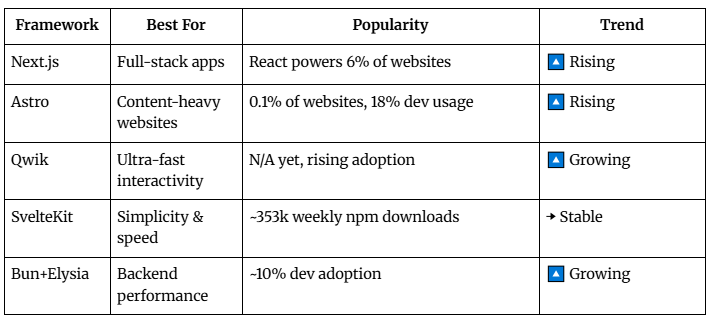
In this guide, we compare the most popular full-stack frameworks in 2026:,,, and. We also include, the structure we're constructing. We believe it's a compelling choice in this area, and we wanted to put it side by side with the established players so you can judge for yourself.
Mastering Multi-Device Content Shipment through Headless SystemsHow to Evaluate the Best CMS
Beyond the usual criteria like designer experience and community size, we likewise examine how well each structure plays with AI coding tools like Cursor, Claude Code, Codex, Copilot, and OpenCode because in 2026, that matters more than ever. We focused on five criteria when assessing full-stack frameworks: How fast can you go from init to a released app? All 5 structures in this guide can be used for full-stack development, but they take various methods: These are the original full-stack structures.
Mastering Multi-Device Content Shipment through Headless SystemsTheir frontend story differs, e.g. Laravel sets with or Livewire, Bed Rails has Hotwire/Turbo, and Django uses design templates or a different medical spa. These are fully grown, battle-tested, and genuinely full-stack. If your definition of full-stack is "manages everything from HTTP request to database and back," these structures accomplished years back. Covers client-side rendering and server-side reasoning (API paths, server elements), however the database layer is completely Bring Your Own (BYO).
It utilizes a declarative setup file that describes your paths, authentication, database models, server operations, and more in one location. The compiler then produces a React + + Prisma application.
Essential Front-end Design Principles for Next-Gen Apps
Laravel has actually been the dominant PHP framework for over a decade, and it shows no indications of decreasing. Laravel has a long custom of incremental, developer-friendly enhancements. With over and utilized by 61% of PHP developers, Laravel's community is massive and active. meaningful, ActiveRecord-style database layer integrated auth scaffolding for email with optional WorkOS AuthKit for social auth, passkeys, and SSO fully-managed releases with Laravel Cloud, or VPS server management with Forge utilize React or Vue as your frontend with server-driven routing built-in job processing and real-time functions zero-config local advancement environment Exceptionally mature ecosystem with services for nearly every problem Excellent paperwork often pointed out as the gold basic Huge job market, specifically for companies and SaaS business First-party tools for deployment, billing (Cashier), search (Scout), and more Active release cycle with yearly significant versions PHP like it or dislike it, numerous JS/Python developers won't consider it Frontend story needs additional setup (, Livewire, or a different medical spa) Performance requires tuning for high-concurrency applications Enterprise applications, SaaS items, agencies, and teams already purchased PHP.
Laravel's constant conventions and excellent documents mean AI tools can generate reasonably accurate code. However, the PHP + JS split (if using Inertia or a React medical spa) implies the AI requires to understand two separate codebases. AI-coding tools work well with Laravel, but the full-stack context is split throughout languages.
Rails 8.0 (launched late 2024) doubled down on simplicity with Kamal 2 for release, Thruster for HTTP/2, and the Strong trifecta (Solid Cable television, Strong Cache, Solid Line) changing Redis dependences with database-backed options. Bed rails has around and a devoted, experienced community. the ORM that influenced every other ORM release anywhere with zero-downtime Docker releases modern-day frontend interactivity without heavy JS database-backed facilities, no Redis required (brand-new in Rails 8) batteries included for e-mail, jobs, and file uploads Convention over configuration means less decision tiredness Incredibly efficient for waste applications and MVPs Fully grown environment with gems for nearly whatever Rails 8's "no PaaS" approach makes self-hosting simple Strong viewpoints result in consistent, maintainable codebases Ruby's task market has actually shrunk compared to JS, Python, and PHP.
Rails' strong conventions make it relatively predictable for AI tools. Like Laravel, the backend (Ruby) and any contemporary frontend (React by means of Inertia or API mode) are different contexts the AI need to juggle.

With approximately, Django has one of the largest open-source neighborhoods of any web structure. Python is the language of AI and data science, making Django a natural option for groups that need web applications securely integrated with ML pipelines.
Will AI-Driven Development Change UX in 2026?
If your backend does heavy data processing or integrates with AI designs, Django is a natural fit. Also exceptional for federal government, education, and business contexts where Python is standard. Python is the language AI tools comprehend best, so Django backend code gets exceptional AI support. The disconnect between Django's backend and a modern JS frontend indicates AI tools struggle with the full-stack photo.

Latest Posts
Key Decisions for Choosing the Next CMS
Leveraging Advanced AI to Scale Editorial Production
Driving User Retention Via Advanced Interface Styles